So here’s what’s been rattling around in my head this week. And I want to warn you, this one’s a little personal. This one’s a little close to the bone. Because I’ve been thinking about the word “creative.” And I’ve been thinking about how much of my life I’ve spent not being creative, even though that’s supposedly what I do.
Here’s the thing. You didn’t get into this to do marketing. Nobody does. Nobody wakes up at eight years old and says, “You know what I want to be when I grow up? I want to be a person who optimizes a content calendar.” Nobody ever said that. No kid ever said it. No teenager ever said it. Not once. Not ever.
You got into this because you had something in you. A song. A story. A painting. An idea. A weird little voice that wouldn’t shut up. You got into this because making things is the only thing that makes you feel like yourself. You got into this because there’s a moment, and if you’re a creative, you know the moment I’m talking about, where the thing you’re making starts to exist outside of you. It’s got its own shape. It’s got its own gravity. And for a second, you’re not you anymore. You’re just the vessel. You’re just the hands. And that feeling is better than anything.
That’s why you’re here. That’s the whole reason. Everything else is admin.
And yet.
And yet here’s what actually happens. Here’s the real day-to-day of being a creative in the year of our internet, 2026. You wake up. You make coffee. You sit down to create. And then you spend the next six hours doing everything except creating.
You write a caption. You pick a thumbnail. You crop it four times. You think about whether you should post it now or wait until the algorithm likes you more. You write the same post for Instagram, and then for Facebook, and then for LinkedIn, and then for the little app that only six people use but you’re pretty sure you should be on anyway. You answer DMs. You answer the comments. You get into a fight with a stranger about a comma. You check your analytics. You check them again. You check them a third time, because the number changed, and now you feel something about it, and the feeling is bad.
And then it’s five o’clock. And you haven’t made anything. And you feel like garbage. And you tell yourself you’ll make something tomorrow. And tomorrow the same thing happens. And the day after that. And the day after that.
And slowly, and this is the part that scares me, this is the part I actually want to talk about, slowly you stop being a creative who does marketing. You become a marketer who used to be creative. And that is a death. That is a slow, quiet, boring death. And nobody sends flowers. Nobody even notices. The feed just keeps scrolling.
I’ve been there. I’ve been there so many times. I’ve had stretches where I made nothing for months because I was so busy “building my platform” that I forgot I was supposed to have something to put on it. I was so busy setting the table that I never cooked the meal. And I’d look at the table, and it was a beautiful table, and there was nothing on it. And I’d feel this hollow feeling. This feeling like I’d been tricked. Like I’d been sold a job I never applied for.
And here’s the thing I’ve come to understand, and I think it’s the most important thing I can tell you. The problem is not that marketing takes time. The problem is that marketing without a system takes all the time. It takes whatever time you give it, and then it takes more. It expands like foam. It fills every available space in your brain. Because when there’s no system, every single decision has to be made from scratch. Every post is a new crisis. Every week is a blank page. And a blank page, for a creative person, is the most terrifying object in the known universe.
But a system? A system is not a blank page. A system is a set of rails. A system says: on Monday, I do this. On Wednesday, I do that. This is where the ideas live. This is how the ideas get made. This is how the ideas get out into the world. And once the rails are laid, you don’t have to think about the rails anymore. You just get on the train and go.
And I know, I know, that the word “system” makes creative people bristle. It sounds corporate. It sounds like a guy in a vest with a whiteboard saying “let’s circle back.” It sounds like it’s going to sand off all the weird edges that make your work yours. But that’s not what it is. A good system isn’t a cage. A good system is a trellis. It’s a structure that the vine grows on. And the vine doesn’t resent the trellis. The vine goes higher because of the trellis. It gets more sun. It gets more air. It gets to be more of itself than it ever could lying on the ground.
The system is what buys you back the thing you actually got into this for: time. Time to stare out the window. Time to read something weird. Time to be bored, which is where half the good ideas come from, by the way. Time to make the thing. And then make it better. And then make it worse on purpose, just to see what happens.
And here’s the second thing I’ve learned, which is the harder one. A system has to be efficient. Not because efficiency is noble. Because efficiency is merciful. Because every hour you spend on marketing that didn’t need to be spent is an hour you didn’t spend on your actual work. Because every decision you make twice is a decision that stole something from you. Because the point of marketing is not to be good at marketing. The point of marketing is to get your work in front of people who will love it, so you can keep making it. That’s the whole point. The marketing is a means. The work is the end.
So what does an efficient system actually look like? I’ll tell you what it isn’t. It isn’t you, at eleven o’clock at night, posting something you made eight hours ago, and then refreshing the page. That’s not a system. That’s a gambling problem.
An efficient system is, more or less, a few things. It’s a place where ideas go when they show up, so you’re not trying to remember them at the moment you need them. It’s a rhythm, a cadence, a schedule that you chose in a calm moment and that you follow in a chaotic one. It’s a small set of channels you actually commit to, instead of a giant set of channels you half-ass. It’s a way of repurposing one piece of work into many pieces of content, so you’re not generating from nothing every single day. It’s a way of capturing the people who find you and moving them somewhere you own, which, as I’ve said before, is the difference between renting and owning.
And most of all, it’s boring. A good system is deeply, gloriously boring. Because boring is what lets you save your energy for the part that isn’t boring. Boring is what lets you be wild in the work.
I spent years learning this the hard way. Years of scattered effort. Years of starting over. Years of doing things because I saw someone else do them, without any sense of whether they fit into a bigger picture. And eventually, slowly, painfully, I started to figure out what actually works. What actually matters. What you can safely ignore. And I started writing it down.
And then I realized I had enough of it written down that it was basically a book.
So.
Here’s the part where I tell you about the book.
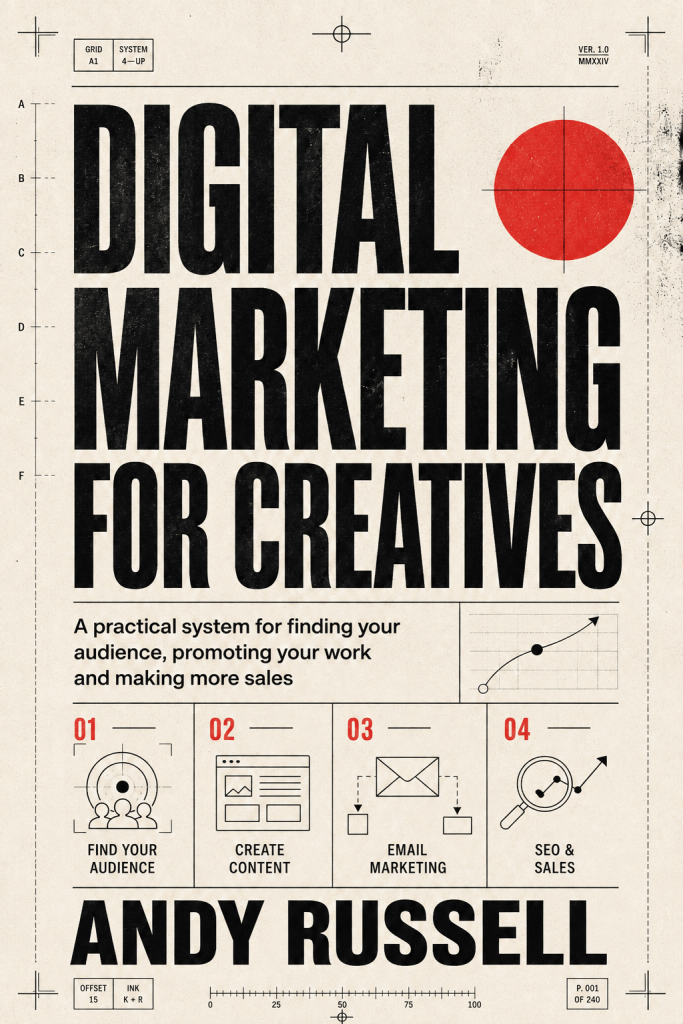
It’s called Digital Marketing for Creatives. And I want to be really clear about what it is, because it’s not what you might think. It’s not a book about becoming a marketer. It’s not a book about “building your personal brand” in that hollow, soul-sucking way. It’s not a book that’s going to turn you into one of those people who talks about “content” like it’s a personality.
It’s a book for people who would rather be making things. It’s a book for people who feel a little sick every time they have to promote themselves. It’s a book for people who have a folder full of unfinished projects and a browser full of open tabs and a vague, gnawing sense that they’re doing this wrong.
And what it does is pretty simple. It gives you the system. The rails. The trellis. It walks you through the whole thing, where to put your work, how to talk about it, how to build the channels you own, how to make one thing go further, how to do it all in a way that fits into a life that’s already full. It’s practical. It’s specific. It’s meant to be used, not admired. It’s the book I wish someone had handed me fifteen years ago, so I could have spent those fifteen years making things instead of refreshing analytics pages.
Because that’s the goal. That’s the whole point. Not to be great at marketing. To be great at making, and to have a marketing system that quietly, efficiently, boringly makes sure the right people find you.
You didn’t become a creative so you could spend your life in a spreadsheet. You became a creative because you had something in you that had to get out. And the system is how you protect that thing. The system is how you keep it alive. The system is how you get to keep being the person you actually are.
Okay. I think that’s it. I think I’ve said what I needed to say. Go make something. And then go find your people. The book’s out there if you need a map.
Let’s get out of here.


Leave a Reply